We just posted our latest video, you can check it out, link down below – LJ
Venice
Benvenuto and welcome to this blog post all about Venice and my favorite spots.
VENICE
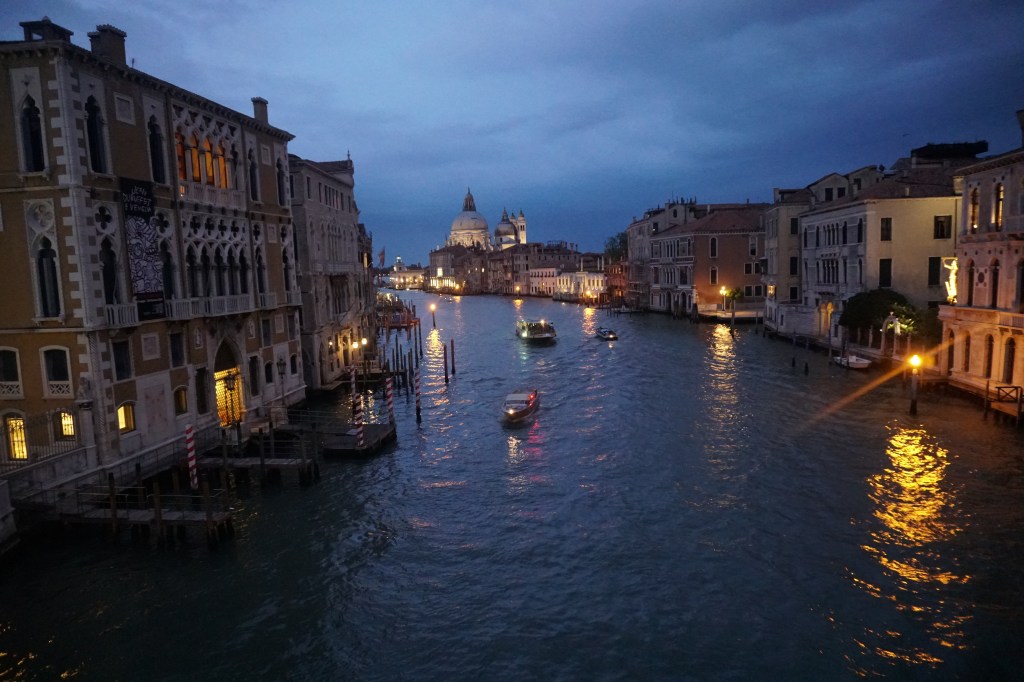
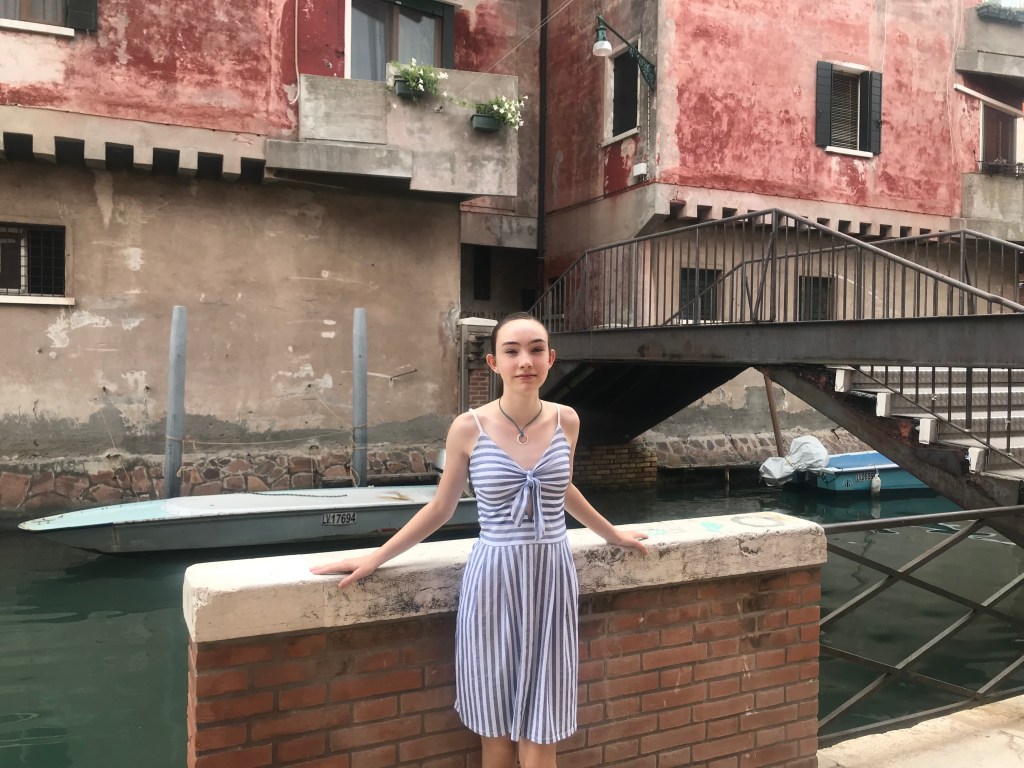
I’ve been wanting to go to Venice for a while now and hearing about it from friends who had been there before only increased my eagerness. Now that I’ve been there I know. I love Venice because of its beautiful architecture and scenery, and incredible canals that weave throughout the whole city. I always thought Venice was beautiful based on all the paintings I saw, and now I know that it is. Its the perfect place for an artist to visit; there are are dozens of postcard worthy landscapes and old Venetian buildings that add a romantic touch to the city.
CROSSING THE CANAL
Venice is very different from everywhere else in the world because instead of having buses, cars, or trains to get to places, they have ferries and ferry stations. When we arrived at the airport in Venice, we got on a water bus to be transported to the location where we were staying.
Because Venice is built on the water, there are only two ways of transportation. By boat, or by foot. For the few days we had in Venice, we walked almost everywhere. But twice, instead of walking a little ways to cross the bridge when we were in a hurry to get somewhere (because there are bridges everywhere), we ended up paying 4 euro to cross the canal by gondola. The trip across only took about a minute, as it was just like crossing the street except you had to hop in a boat in order to do so. By going on a gondola to cross the canal, we saved 20 minutes that we would have used walking.
Gondolas are what Venetians call the long canoes where the people rowing, which in Venice are called gondoliers, stand up on the back of the boat with a long oar in hand. Many gondoliers decorate their gondolas with fancy tasseled couches and chairs colors gold and red which the passengers sit on. A lot of them also wear similar clothing if they are part of the same business. For example, we saw many of them wearing red and white striped t-shirts. Some tourists pay high prices to go on gondola rides through the canals, but we never thought of doing that because of the expense and it was just too touristy.
THE RIALTO BRIDGE
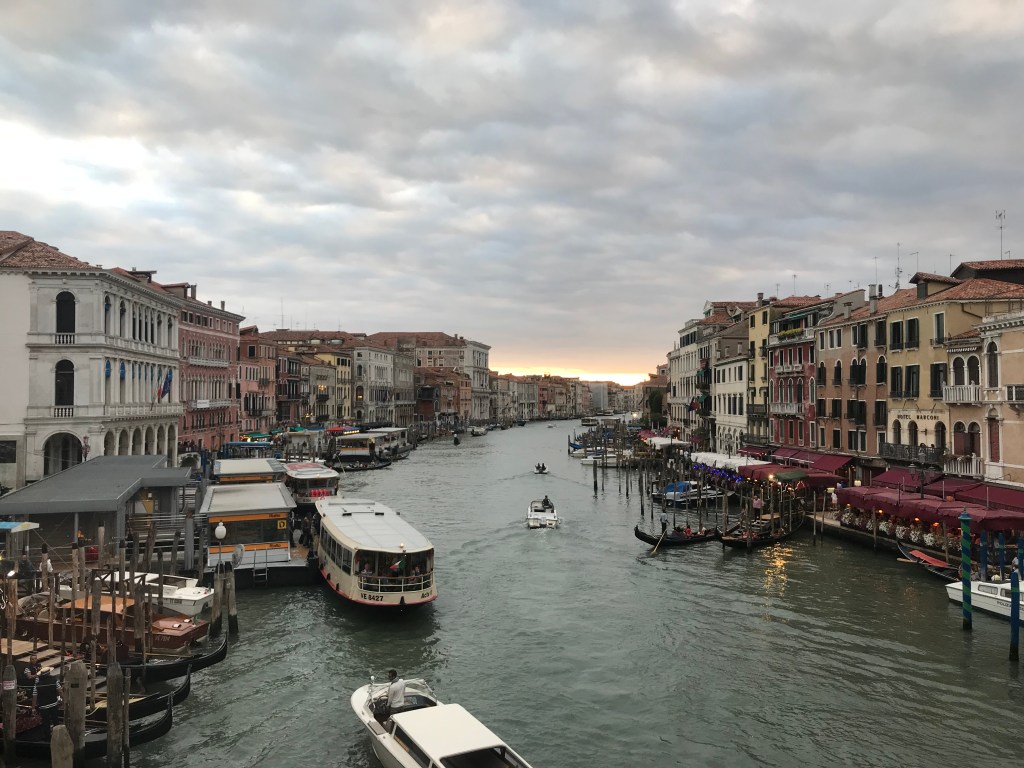
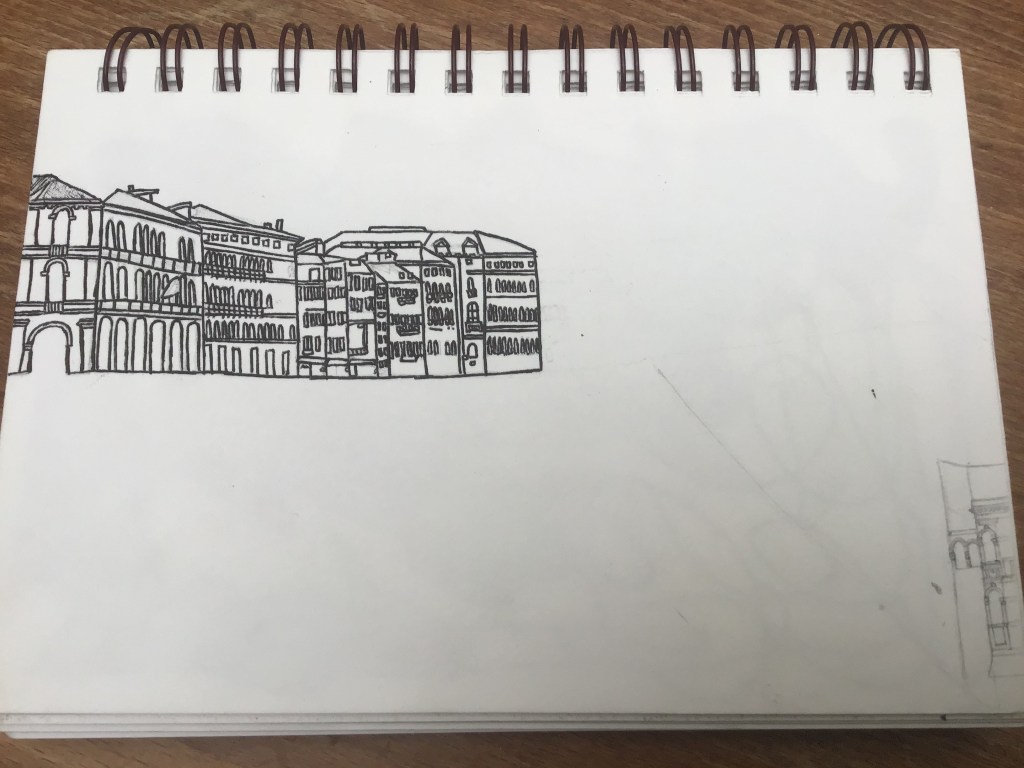
There is a famous bridge in Venice that is always crowded with tourists trying to catch a view of the Grand Canal. From the Rialto bridge you can see all the beautifully colored Venetian buildings with their intricate arches and windows. You can see all the hotels with names such as Hotel Marconi, and restaurants covered by red colored tents to keep dry from the rain and block the sun. The view from the Rialto bridge is very well known and there have been many paintings made of it. Speaking of which, currently I am making a drawing of the Grand Canal. See a sneak peak at what it looks like so far down below*.
THE BIENNALE
Venice has been known, (for the past 123 years) for its famous arts festival, The Biennale, where artists from all over the world enter world changing (and probably mind changing) art pieces. The Biennale is held at two main locations: The Arsenal, and the Giardini.
The Biennale arts festival in nothing like you’ve ever seen before. The art exhibits and pieces can take up a large quantity of space, and consist of many different forms of art. Many exhibits include installations and movies made to show some type of theory or form of thinking.
When we visited the Biennale, we went to the Arsenal and the Giardini. Every year, there is a theme that all of the artists incorporate in their art. The theme of this years Biennale was, “May you live in Interesting times”. In my opinion, the theme should have been May you live in Disturbing times, because most of the exhibits had a very ominous or unsettling feeling which really set the mood for the whole festival. A lot of them consisted of angry zombie-like animated people that were produced on projectors, and robots, photographs, movies, or models of mannequins that looked or seemed somewhat human-like. At first look, the mannequins in some of the photographs looked scarily human-like, but when you looked more closely, you could see that they were just models of humans. Many of the movies were based all about global warming which was definitely a reoccurring theme displayed in the artists work.
Not every art piece was like that though. One series of rooms displayed many geometric and organic sculptures and some of them even moved. In another room, there was a large sculpture of a human in a rocking chair made out of clothes. There was also a really cool animated movie of a sandwich making itself.
One of my most favorite exhibits was the giant robot programmed to clean up paint.The robot in that exhibit looked sort of like a giant shovel that was attempting to wipe up all the puddles of paint while doing programmed dance moves, but failing to succeed because all the paint kept on expanding into larger puddles. It was supposed to represent how people do endless hard work and the work never stops.
Another one of my favorite exhibits was the Italian Pavilion. We waited in a long line for about an hour because they only let in less than 10 people at a time to enter the exhibit. We were asked to remove our shoes and then we walked on a plastic casing that had water underneath (sort of like a waterbed). I think that the artist was trying to show how the sea levels are rising, which will eventually flood Venice.
Link to the Biennale web site: https://www.labiennale.org/en
THE PEGGY GUGGENHEIM MUSEUM IN VENICE
Peggy Guggenheim was an art collector of modern art who grew up in New York City during the early 1900s. In 1912 when Peggy was only 14, her father died as a passenger on the Titanic. Peggy inherited a fair amount of money and supported the careers of many modern artists. After World War II, Peggy bought a mansion in Venice facing the water to display her art collection and lived there until she died in 1979 at the age of 81. The Peggy Guggenheim museum is held at Peggy’s former home. My mom recommends Peggy’s memoir, Confessions of an Art Addict.
Thanks for reading this blog post, and make sure to subscribe to our YouTube channel, there are a lot of new videos coming out! I’ll be back with another post soon!
- Lily🍦
Delphi – On the Road with LJ
We just posted our latest video, you can check it out, link down below – LJ
“Next Stop: Meteora, Greece” – On the Road With LJ
We just posted our latest video, you can check it out, link down below – LJ
Europe: Summary (By Jack)
EXCITING NEWS!
Hey everyone, I’m back with another post! But this is not just any ordinary post, actually this is special. Our family is leaving Europe and heading to Africa! In Africa, we are going to be seeing some amazing things. But this report is about Europe. I’m going to be giving an overview of all of this first continent out of the three we will be going to on this trip. Feel free to take a long time reading and processing this report because this report will have a lot of information.
EUROPE:
LONDON, UNITED KINGDOM 🇬🇧: Our first destination on this trip was London. We had been thinking for a long time about the first place to go, and it turned out in the end to be London. And I think this was a good idea! Before that, I had never went to the UK. We went to the Imperial war museum, British museum, Kings cross station, The National Gallery, Greenwich, Sky garden, HMS Belfast ship, Tower of London (search on this site for Lily’s report), and the Cutty Sark ship (search on this site for my report). All of these I would advise you to look up and/or visit one day.
Good site for more info on London: press the link down below.
http://www.localhistories.org/london.html
Youtube video from our channel about London:
SPLIT, CROATIA 🇭🇷: I had barely even heard of this country before we made plans to go there, and I had most definitely had never heard of such a wacky name for a city, like SPLIT. What? You’re probably thinking. Who names their city Split? Well there must be a story behind everything. I learned that a long time ago. You probably did too. In Croatia there are Roman ruins. Well, yeah! That’s because Rome took over all of Europe! But in Split there are some extremely impressive things. These include, a whole burned and destroyed city called Solona, and a huge, well preserved palace built by the all famous emperor Diocletian (search on this site for my report). Which we all saw.
Great site for Split history:
https://www.total-croatia-news.com/split-history/8421-a-brief-history-of-split
YouTube video from our channel about Split:
SARAJEVO, BOSNIA & HERZEGOVINA 🇧🇦: Over thirty years ago, there was a war in the old country of Yugoslavia. There were many cultures involved. But the craziest and worst things happened in Sarajevo. It was called a siege. We learned and heard stories about people’s experiences in the siege. A siege is where one large group surrounds all around. So the citizens of Sarajevo would not be able to get out of their city for supplies. Many people died this way. It was sad to learn about all of it but was also a really good experience learning about it.
A little timeline of Sarajevo:
https://www.latimes.com/travel/europe/la-tr-d-sarajevo-timeline-20140727-story.html
YouTube video from our channel about Sarajevo:
BIOGRAD NA MORU, CROATIA 🇭🇷: In Biograd, we went sailing and did tennis. We called it tennis and sailing camp week. Since me and Lily had never took sailing before that first day, it really turned out to be a blast. We road on the trapeze, and even flipped the boat over on the third day. It was creepy to have our boat slowly leaning to one side and then tilting so much it completely flipped over and threw us off. But, eventually it just HAD to happen, and, we did learn from it (Search learning ` for lily’s report). For tennis camp, our whole family got mixed and private lessons. My parents played matches against the locals. My sister and I had lessons with the local kids every few days. But all in all, it was kinda busy, but in most ways, it was a fun week.
YouTube video from our Chanel about Biograd Na Moru:
ATHENS, GREECE 🇬🇷: In Athens we saw some of the most amazing Greek ruins in the world. Well, obviously there are Greek ruins in Greece because Greek ruins are Greek! And yes, that’s true! So, my family wanted to start seeing some ancient civilization. Athens is the place to go. We had known we wanted to go to Greece for a really long time before we left, but I actually did not know we would go to Athens. But why is Athens so cool? The Greek acropolis and the ancient agora is the answer. Huge walls and temples sit on the top a a HUGE cliff that you can see from miles away. The most well known thing there that we saw was the Parthenon. Most of the statues and frescoes are in the British museum Which we saw in back in London. Others are in the acropolis museum. Other temples on the the Greek acropolis include, the temple of Poseidon, and the temple of nike (the god of victory, I know- I confused it with the brand too). The ancient agora is considered one of the first shopping malls. It was a huge section of unbelievable ruins.
History of the Greek acropolis and agora:
Agora: https://ancient-greece.org/archaeology/agora.html
Acropolis: https://ancient-greece.org/history/acropolis.html
YouTube video from our Chanel about Athens:
KALAMBAKA, METEORA, GREECE 🇬🇷: There are a lot of Amazing places in Greece that are not just Athens. For example, Meteora. Meteora is a large section of crazy cliffs surrounding a few towns in Greece. Kalambaka is among these towns. After Athens, our family wanted to spend a little more time in Greece before leaving, so we took a car trip around Greece. And we started in a small town in Kalambaka . Why not one of the other towns near it? Because unlike anywhere else I’ve ever heard of, there are monastery’s on top of the cliffs. The monastery’s are places where Christian monks have lived in since the thirteen hundreds. Sometimes, in the morning, you can hear them chanting from somewhere above. There are six monasteries, and each is unique in its own way. It was a once in a lifetime experience.
How the monks live in the cliff top monastery’s:
https://www.thebyzantinelegacy.com/meteora
DELPHI, GREECE: Our second and final destination on the Greece car trip was Delphi. According to a myth, Zeus (the king of the gods), sent two birds flying in opposite directions, and he said that wherever the birds met, would be the center of the world. And guess where the birds met? Delphi! So to mark down the center of the world, Zeus brought down a large rock carving which can be seen in the archeological museum of Delphi today. Delphi was an Oracle. Priestesses who supposedly could talk to the prophecy God Apollo would answer questions to anyone who paid them. They would ask Apollo (who would tell them the future) and then pass on the information to the questioner. We saw the temple in which the priestesses would be stationed, the treasury of Athens, a Greek theater, a roman amphitheater, and much more. (Search, what did the ancient Greeks eat? For my ‘’Delphi report)
The oracle of Delphi and more:
https://ancient-greece.org/history/delphi.html
VENICE, ITALY 🇮🇹: My sister really wanted to go here. Personally, I did too. Venice is like a bunch of islands split into canals. When we arrived in Venice, we took a water taxi from the airport. That’s right, a water taxi! In Venice, they don’t have cars (must b good for having less pollution!). Only walking and boating. So to get around, we just walked across bridges and took a few water-cabs. There are a lot of unbelievably crazy and awesome things in Venice. We saw the Doges palace, which is a fancy Venetian palace decorated with paintings and lots of gold (yeah, the Venetians were RICH!). We also saw the Bridge of Sighs (look it up o the internet!), the Peggy Guggenheim museum, and the famous around the world art festival, the Biennale. Which I all recommend.
All about Venice:
https://www.britannica.com/place/Venice
ROME, ITALY: Rome was my request because I wanted to see some more ruins. We saw and went inside one of the wonders of the world. The Colosseum is one of the most visited land marks in the world! But as I said earlier, there’s a story behind everything. There are a lot of stories behind the Colosseum. But see the report before this for information about that, because I don’t want to want to make this 15 pages long! In Rome we also saw the Roman Forum, which was the ancient place of government for Rome. The Vatican was also really something. Saint Peter’s Cathedral was just huge! We got to see the Sistine Chapel which is a church decorated with some of the most famous paintings ever by Michelangelo. (Search, touring the Colosseum in Rome for me and mom’s post)
More about Roman history:
https://study.com/academy/lesson/roman-civilization-timeline-facts-contributions.html
SICILY, ITALY: Surprise, Surprise! Another car trip! But this we went to a few towns and cities in Sicily. First, we went to a beach town, San Lorenzo. We went to the beach right in the back of our Airbnb every day we were there. Then, after, we headed to a small city called Noto. While there, we met up and stayed with friends and mostly just hung out. But, we did a little bit of walking around too. Following Noto, we stayed in a town called Piazza del Armerina. There was a huge Roman villa with the name, Villa Romana del Casale and some of the best preserved mosaics in the world there!
More Info on Villa Romana del Casale: https://www.thethinkingtraveller.com/thinksicily/guide-to-sicily/archaeological-sites-in-sicily/villa-romana-del-casale.aspx
Lastly, we went to the Valley of the Temples. Yes, its a Valley of the Temples! We saw ancient city walls, a village of ancient houses, and over four temples!
The city of the temples: https://www.thethinkingtraveller.com/thinksicily/guide-to-sicily/archaeological-sites-in-sicily/the-valley-of-the-temples-agrigento.aspx
Please feel free to leave a suggestion, or just a note in the comment section below.
On a final note, if you haven’t already, please subscribe and like the post. Also, we have a YouTube channel called ON THE ROAD WITH LJ so please also subscribe to that.
We will have a new video and post soon.
-Jack👌
“Next Stop: Athens, Greece” – On the Road With LJ
We just posted our latest video, you can check it out, link down below – LJ
Touring the Colosseum in Rome [By Jack and Emily]
Touring the Colosseum in Rome: A Conversation with my Mom a few weeks ago based on our tour.
Jack: What do you want to talk about mom?
Mom: I am processing everything we learned about the Flavian Amphitheater, known as the Colosseum. What do you recall?
Jack: Mostly all the cool stuff we saw when we were touring. Like first seeing the colosseum and walking inside it.
Mom: The colosseum is massive! What was your favorite part?
Jack: Oh yeah! I remember how there was the huge weight that would carry up big beasts for animal fights in the Colosseum! Wasn’t that so cool?
Mom: Can you imagine what it was like to lift the black bears, panthers, lions, elephants and other exotic animals up to the stage? How did they do it, did they pull ropes?
Jack: Don’t you remember that they didn’t really pull ropes that much to bring the animals up? The Romans would actually put a weight that was much more heavy than the beasts on the top of the rope line, and then the animal on the bottom. But the animal would not only be tied to the weight, it would also be connected to the ground! That way, when it was time to bring the beast up to the fighting arena, all the Romans had to do, was undo the rope tying the animal to the ground, and then the bear or lion would be up and ready to fight! So they really did not need to pull ropes for that.
Mom: My favorite part of the colosseum tour was learning about the real purpose of the colosseum; it was all about the politics, not just fun and entertainment for 50,000 spectators 100 days a year. Typically a household would be allowed to visit 3 times a year and they would be allotted 5 free tickets for each game. Tickets were originally made of stone and later would be made from ceramics. Families lived together in multigenerational homes of about 15-20. Who would get to go from the household?
Jack: Oh, well, what is your interactive hypothesis on that pondering question?
Mom: Ok, I’ll answer my own question. Rarely women. The veterans and elders had first priority. Younger men from the household may have been enrolled in the army and away for years at a time. A ticket would guarantee a day of feasting and a shocking series of entertainment.
Jack: yeah, I think they got a lot of free wine, meat and bread on those occasions. Don’t you remember that the colosseum was a lot of times actually used for politics! The emperors and senators would take advantage of all the people to express their ideas with whenever there was an occasion at the colosseum.
Mom: The colosseum was organized by neighborhood and by class. The emperor would enter the stadium from whatever side he was trying to impress.
Jack: Yeah, but remember that the senators and governors of Rome would also have a special walkway! But they only got to be on the outside entries because they were not as important compared to the emperor.
Mom: What types of entertainment did the people see?
Jack: I think there was a lot of gladiator fighting, because that’s what’s the colosseum is mostly known for. But there was also many other things seen there.
Mom: There were circus shows, criminals were executed, famous battles were re-enacted, all in the name of “entertainment”, and surely it was how the Roman Empire showed their power and control. There were no movies or tv after all. Killing really became a spectacle sport, just like in our culture when we see a hero kill a villain in a film. Isn’t it amazing how many men died fighting, whether they were fighting animals or fighting each other? It’s possible that 400,000 men and 1,000,000 animals died there.
Jack: Yeah, pretty creepy! But all we’ve talked about was Roman stuff, what about after the empire fell? What happened to the colosseum? I think I remember learning about some things that happened there after the Romans.
Mom: In the Middle Ages the water supply was attacked by the many conquerors of Rome and a huge percent of the population fled the city. It was chaos. The purpose of the Colosseum changed significantly.
Jack: I remember how the colosseum became like a little town, there were a bunch of crammed houses. Must have been hard to live there knowing that people used to die in the place of your house!
Mom: The Colosseum did become a place where people lived with their workshops, gardens and animals. Ironically, it actually became a cemetery too. It was ransacked for it’s valuable steel bars and even the stone was used to build other monuments around Rome. Multiple earthquakes destroyed parts too. Later it was briefly converted into a fortified castle for a ruling family, the Catholic Church took it over and turned it into a hospital and a quarry and eventually, Mussolini motivated to restore the grandeur of ancient Rome’s monuments.
Jack: In the Christian period, the Vatican took marble, statues, and important artifacts that were held in the Roman colosseum. Guess where they put them? Well, churches! So a bunch of those churches we saw in Rome while we were there maybe had some ancient Roman materials on them! Some could even be from the colosseum!
Mom: I wonder too. There is so much more to learn! We hope that we sparked your interest about the Colosseum.
Here are a bunch of the resources we read:
https://blog.globol.com/en/art/europe/italy/rome/colosseum-history-facts-anecdotes-6
https://www.smithsonianmag.com/history/secrets-of-the-colosseum-75827047/
https://www.history.com/topics/ancient-history/colosseum
https://commons.trincoll.edu/historyblog/2012/11/07/mussolinis/
“Tennis and Sailing Camp” – On the Road With LJ
We just posted our latest video: “Tennis and Sailing Camp, Biograd na Moru, Croatia”
You can check it out, link down below – LJ
What did the ancient Greeks eat? (By Jack)
Hi everyone! You’re probably wondering how I got this topic, and no, it was not just a coincidence. When we were touring around Delphi (the town in Greece we’re visiting now), an obvious question popped into my mind. To survive, the ancient Greeks would have to eat. What did they eat? How did they do it? What, why, when, where, how? I am writing to answer those questions. Hope you enjoy reading!
What did the ancient Greeks eat?
The ancient Greeks had a mostly healthy diet, but they still ate really good food. Growing is one of the best ways to make food, and the ancient Greeks knew that. The ancient Greeks grew lots of crops. These include figs, olives, and grapes. The ancient Greeks also loved meat. As one of the most popular foods ever eaten, meat has been around for a long time. Fish was also eaten in ancient Greece wherever there was water. Since Greece was surrounded by lots of water, fishing was big. The Greeks ate all kinds of fish. As among the healthiest things to eat, vegetables were one of the main things the Greeks ate in ancient times. It was a good idea for keeping their warriors healthy. There are a few other things that I should mention about ancient Greek food. A little Greek something to eat.
Why are you talking about olives?
Because of it’s many uses! One of ancient Greece’s main resources that had to be grown, was olives. They made press mechanisms out of wood and stone. Later in Roman times, the Romans also used the idea of olive oil presses and we saw one in Diocletian’s palace. (Remember from my report on him?) Olives were very important because they could do a lot of necessary things. For example, olives served as food, and could be pressed into olive oil, which would serve as food and medicine too. Olives were one of the only and best materials for making medicine.
Why grapes?
Because of the wine! Grapes were also a very important food for the Greeks. This was mainly because of wine. Whenever there was a special celebration, the wine would be brought out in a large barrel for all the guests. Before filling up the glasses from the barrel, water would be added to the wine. This was because at a party, nobody wanted to get drunk, the point of the party was mainly to talk. If you got drunk, you would not be able to do that. This tradition was all about wine, and wine came from grapes. because of this, grapes were a very important food to the ancient Greeks.
Didn’t the Greeks eat meat?
Well… yeah! Many humans live off of other animals! Mostly only the rich and important people would eat meat, but on special occasions (for example, the Panathenian festival dedicated to the goddess Athena) all or most of the ancient Greek citizens would sacrifice animals and offer the meats to their gods and then be able to barbecue and feast on the offerings. So usually only in special times would the lower classes be able to eat meat. It was an honor for years to eat meat. The ancient Greeks bred lots of goats and ate many other varieties of meat.
You forgot fish!
Yes and no. Up until this point I delayed this topic, but here I am. And yeah, fish was eaten at this time. It was a very important to the ancient Greeks. Fish was cheaper to buy and catch than meat. Fishermen used very sophisticated techniques to catch their fish. Sometimes, fresh fish was transported inland where there was no water. but since Greece was surrounded by lots of water, it was handy for fishing.
Weren’t vegetables important?
Of course they were! I’m not trying to turn you into a vegetable lover or anything, but they are healthy! And the Greeks must have known that back then, because that was one of their most eaten foods! But don’t forget vegetables! They grew and ate lots of vegetables! Because it was so much farming land, veggies were key. The ancient Greeks grew almost every single vegetable that you can imagine. Like carrots, lettuce, beats, cabbage…ex… Ancient Greeks knew that if they wanted to survive, they would have to eat… vegetables.
What about everything else?
Yes, there are a few more things I want to cover in this report. first, bread was very important. I know I keep on saying stuff like that, but really, it was! Today, bread is eaten almost every second in the world! I can’t really explain all about ancient bread, but what I can tell you, is that (just like now a days) the ancient Greeks were big on bread! Second of all, cheese. The Greeks ate cheese with honey and fruit, and liked salting their cheese as well. So if they got the chance, the ancient Greeks would love to feast on some cheese!
A lovely snack.
While I was researching, I came across something that looked good. now here it is: If you want to have something very Ancient Greek, have this. An assortment of Greek cheeses with honey on the side to dip with, and fresh fruits to make it taste better (especially apples). I think it would also taste good with some crunchy bread.
Thanks for reading my blog post on ancient Greek food, I got this idea when my family was touring Delphi, Greece. So since it was such an interesting and obvious question, I wrote about it. If you’re really interested in this topic, then you can visit these websites that I used in my studying by clicking the links down below.
⬇️
http://www.primaryhomeworkhelp.co.uk/greece/
https://en.m.wikipedia.org/wiki/Ancient_Greek_cuisine
https://www.britannica.com/search?query=Ancient+Greek+food+
Please feel free to leave a suggestion, or just a note in the comment section below.
On a final note, if you haven’t already, please subscribe and like the post. Also, we have a YouTube channel called ON THE ROAD WITH LJ and you can access our channel page by pressing the link down below.
⬇️
https://m.youtube.com/channel/UCheQcg1OwJ-v-eUV4SNhVwA
Learning How To Sail (by Lily)
TENNIS CAMP IN CROATIA —August 31-September 7—
LEARNING HOW TO SAIL
We went to a camp in Biograd na Moru, Croatia for a specific reason. To play lots of tennis. And we did. But in addition to that, my brother and I got to learn how to sail too. Near Biograd na Moru, there is a beach that you can swim at, and unlike Seattle the water is warm, so it was the perfect place to learn how to sail. Today I’m going to to be telling you what it was like to learn how to sail in the Adriatic Sea.
We learned how to sail in four days. Every day at 2:00PM, we got dropped off in Pakostane at a boat renting place where we met our sailing teacher for private lessons. From 2:00 to 4:00 we were out on the Adriatic.
When we got there, we put our life jackets on, and got the 14 foot catamaran ready to set sail. In order to get a small catamaran prepared, all you have to do is put both sails up, make sure the halyard and the capsize line are tucked away in the pockets on the boat, and prop the boat up on a trailer so that you can roll it into the ocean.
The first day we started off with our sailing teacher on the boat with us. The winds were pretty calm for what we had ahead of us. That day we practiced jibing (turning the boat downwind), and we practiced stopping the boat. Turning the boat downwind means that the wind is pushing the boat from behind when you turn. When stopping the boat, you turn the boat upwind, or to the direction the wind is coming from, so that there is no wind pushing on the sail, causing the boat to stop.
There are two jobs on a small catamaran like the one we were on. The Skipper; who steers the boat and who is in charge of the main sail, and the crew; who is in charge of changing the smaller sail. These jobs are very important when jibing or stopping the boat.
HOW TO JIBE
Step One: The skipper throws the driving stick into the water and starts to turn the boat downwind
Step Two: Both the skipper and the crew get on their knees, ready to move to the other side of the boat when the main sail changes with the wind
Step Three: The main sail changes wind, and both people move to the other side of the boat, opposite the sail, so that there is an even amount of weight on both sides and the boat doesn’t tip over
Step Four: The skipper grabs the driving stick out of the water and continues steering the boat in the right direction
Step Five: The skipper pulls on the main sail in order to get more wind in the sail
Step Six: The crew changes the smaller sail by releasing the rope of the side the sail is on, and pulls on the rope that is already released, making the sail change sides, catching the wind
The second day, Jack and I went sailing on the boat by ourselves. Our sailing teacher went on a motor boat nearby, and watched us. Our dad also got on the boat with him to takes videos of us sailing. We practiced what we had done the first day with our teacher (how to turn and stop the boat), but this time by ourselves. We had two landmarks that we used to sail to and turn around. We used a red pole that stuck out of the water that was specifically meant for boats to use, and the motor boat that my dad and our sailing teacher were on. We sailed across the water toward the red pole, then turned downwind around it, and sailed back across the water going the opposite way we came from, turning downwind around the motorboat. We mostly did this for the whole two hours, every once in a while practicing stopping the boat.
HOW TO STOP THE BOAT
Step One: The skipper releases the main sail
Step Two: The crew releases the smaller sail
Step Three: The skipper turns the boat upwind or in the direction the wind is coming from
Step Four: The main sail will change and both sails will be on opposite sides of each other. Therefore, no wind will be able to push the boat and it will stop
Now, it was day three when things got a little crazy. Our teacher decided it was time for us to go out in stronger winds. Unlike the other days, the wind was 12 knots. He also decided we were ready to try going on the trapeze. When you go on the trapeze, you have to put on a harness that’s sort of like if you were going zip-lining. On the sailboat there are some ropes with metal hooks on them that connect to the hooks on your trapeze harness. When they are connected, you put your feet on the side of the boat and slowly lean out of the boat, into the wind. Some tips that I learned from our sailing teacher: Spread your legs apart, bent, with your feet planted on the side of the boat, and if you want you can also hold on to a rope in case you end up capsizing.
Our parents also decided to come with us in another small catamaran, and our teacher of course was on his motorboat. He lead us out farther into the ocean then we usually would go (we usually stayed close to the shore because it was easier to practice sailing), but this time we were going to practice what we had learned in higher winds. This was a big step up, and Jack and I didn’t know what we were in for.
At the beginning, it was cool. Jack and I took turns. While one person was on the trapeze, the other was steering the boat. When you’re on the trapeze, it kind of feels like your flying with the wind. Then the wind got stronger as we progressed into the sea, and that’s when things got a little bit out of hand. The waves got bigger, especially when we were following our teacher on his motorboat (which created more waves), and things turned from fun, to downright scary. I’m not sure which was scarier; being on the trapeze and not being in control of the boat, meaning feeling kind of weightless, while big waves splashed you from the sea below. Or, being in control of the boat; meaning, it was your job to try to avoid the bigger side waves from the motorboat, and stick to the middle, where there was a lot of strong wind.
I think I got my answer when it was my turn to drive the boat, or I guess in this case, control it. While my brother was yelling at me, and I was trying to avoid big waves, the boat kept on leaning to one side. I guess you could say this was the tipping point of the story, because suddenly the boat tipped over just like that and we capsized. I fell off first because I was closest to the edge, and my brother held on to the trapeze rope (he wasn’t actually on the trapeze) for a whole two seconds before joining me in the warm Croatian water. If this was the Titanic, I wouldn’t have had much luck.
Our sailing teacher came for us in his motorboat, and our parents had watched every second of it from their sailboat. They brought our Go pro to get some clips for our YouTube channel, but sadly didn’t get our capsizing moment. While our sailing teacher worked on getting the sail boat upright, we lifted ourselves up onto the motorboat, shivering slightly. Although the water was warm and we had swam in it on our first sailing class, the wind wasn’t exactly the warmest. Not only that, but the sailboat we were sailing on had a trampoline as the part you sat on, which was pretty cool when you could swim under it and wave to the person sitting above (It was like a bridge). But it also meant that the waves could lap up from under you every once in a while.
The catamaran was fully flipped over. The white bottom of the boat was all that was showing on the surface of the water, and if you looked below the surface, you could see the bright orange sails from above the water. The boat was still floating (thankfully), and our instructor reached toward it, grabbing the nearest sail and pulling it so that the boat now laid on it’s side. He found the end of the tip of the main sail and pushed, using his strength to finally upright the boat. As we climbed back on to it, the sails, the trampoline, everything was wet. Which was fine of course because it was a sailboat, it was meant to be on water. But, not exactly fully submerged in water though.
Jack and I both made mistakes that day. Jack sharply turned the boat once and when I was on the trapeze, I got knocked back onto the boat. And I capsized the boat. Oops. Turns out I had pulled on the main sail too much and since the wind was so strong, the force turned the boat over. It was pretty scary actually because Jack and I aren’t exactly what you would call pro sailors. We’re still pretty inexperienced. Actually, in my opinion I think it was a little too soon. We only had two days of learning how to sail, and then BAM! We were out in our own sailboat, in high winds just like that. It probably would have been a much more enjoyable and way less scarier experience if we had been practicing sailing on our own for longer. My dad has sailed a lot in his life (he used to own a sailboat) and when he was in the sailboat business, he wouldn’t let people rent one of his boats out unless they showed him that they could capsize the boat, and push it back up again.
On the forth day, our sailing instructor pulled us into the back of the room where all the life jackets were kept. There was a small table and chalkboard. On the table was a small wooden model of a sailboat. He took a piece of chalk and drew a large circle with a piece cut out of it on the chalkboard. He explained that the circle was the cake, and that the piece was a slice someone had eaten. The piece of cake was where the wind was coming from, so if we sailed into it, the boat would stop. He took the model of the boat and moved it across the table, showing different angles from which the wind was coming from. We were going to learn how to sail towards the wind—at a slight angle so that the boat wouldn’t stop.
Once we got onto the boat and sailed out a little ways (we stuck close to the shore since we were learning something new), our teacher explained the objective of the day. There were buoys on the water, placed there to tell boats that they were close to the shore, and we were going to practice sailing at an angle in order not to land in the piece of cake. The “piece of cake” was code for stopping the boat, but wasn’t useful if you were trying to actually make the boat move (or in other words sail). I thought of it like this; the piece of cake was the part that was gone and all used up. It wouldn’t make sense to sail into it because there would be nothing left to eat. In order not to land in the piece of cake and be able to get to your destination (which was in this case a floating buoy), you would have to sail in a zig-zag pattern. The way to do this is to sail at a 45 degree angle, then tack, (meaning you turn slightly without jibing) going in the opposite direction at a 45 degree angle and if you keep on doing the same thing, it’s like your zig-zagging across the water.
We practiced this technique of sailing for a while, but after trying two times to sail to a buoy, tack, sail to the next buoy, tack again, and then sail back the way we came, we ended up not fully succeeding at the task, and our teacher gave up on us, so we did something else with our remaining time. Personally, I would have been fine with continuing to practice tacking, I wanted to keep on trying until we did it without any mistakes. It was a bit confusing because when you sail downwind you have to loosen the sail, and then you have to tighten the sail when you tack.
On our last day of sailing, our dad and Jack and I decided to go sailing on our own. We brought the GoPro to take footage and we tacked to a small island. Then we sailed closer to land, and Jack and I jumped into the Adriatic Sea. It was a way calmer two hour period than any of our other sailing lessons.
In the end, it was a pretty cool experience, and now Jack and I can say that we learned how to sail—in Croatia.
- Lily🍦
 Worldschooling