Hi everybody! I’m here to write a special blog about what we did one day in Morocco. On that day, we got our shoes wet from walking across rivers, got burning hot from the sun, climbed up hills, and walked through Berber villages. But I think it was definitely worth it.
October 18, 2019: Today was a pretty cool day. We got up and had the typical Moroccan breakfast:
Lesson 1: The typical Moroccan breakfast (try making it yourself!):
Breads (warm crepe bread/ normal white baguette bread/ bread buns)
Well anyways, after breakfast, we went on a hike. But we would not have been able to do it without a guide. Interesting fact about our guide: he’s from a 30 person Berber village high up in the Atlas Mountains which is only reached by foot, with no electricity. So our guide led us from our lodging into a really dry sandy desert like area. After walking a ways down, we encountered a river. So we had to cross a few streams of the river before continuing. The guide helped us choose a route over the rocks. I got a tiny bit of water in my shoes, but secretly, I kinda liked the cold water given how hot it was (don’t tell my parents!). Our guide told us a couple of things about the people and the water they can use:
Lesson 2: the Berber privilege of water:
The village council (Jema’a) decides how much water you are allowed to take from the rivers.
Dams are used to take part of the water from the main river and create your own stream so you have a personal spring.
If you do not follow the rules of taking water, the council will switch your dam so you have the same amount as others.
Your own small stream leads usually to a small farm (just a piece of land for planting crops). Then, when you open your dam, you have an easy watering system.
A few things you might grow on your plant farm are: mint, corn, thyme, sugar, almonds, oranges, pomegranates, olives…
The next place we went to was a Berber cave. It was probably the coolest cave I’ve ever seen. It had three floors. We had to climb up this cliff on a really thin trail to get to it. We only went into the bottom floor, but it was huge! The cave spanned back farther than you can even see at the entrance with a flashlight! When you walk in, you have to crouch down because the caves are very low in height. But if you step to the left or right at any time while walking through the hallway, you enter much higher and larger rooms where the Berbers would live their everyday life. So that was definitely one of the best caves I’ve ever seen:
Lesson 3: The hideout cave:
The caves were hideouts from all the wars happening at its time
The caves could have been up to 1,000 years old!
It seemed to me that the cave entrances are designed to be low because heat rises and if there is no space for heat to enter, the caves have a natural air conditioner!
So after seeing the caves, we headed back down the slope to go visit some Berber villages. Our plan was also to have tea in a Berber village. To get there, we got to walk through a few villages before arriving at the one we where scheduled to have tea. When we finally arrived, I was burning hot. No really, it can get warm in northwest Africa! The tea was good. They pour the tea really high to make bubbles. It hit the spot. But mostly the reason that I say this it that they did not only give us tea, but also bread. The bread was pretty similar to crepe bread. It was warm and just… good. Walnuts were also served to us there. It was more than I expected, but still super worth it! And, I was hungry!
After the tea, we started to head back. The hike had seemed very long. It was supposed to be 3 hours, but it did not feel like it. “Hey dad, how long has this hike been, feels more than 3 hours”. And my dad said what I did not expect. “I think about five hours, Jack, not 3”. Even though we surpassed our time by 2 hours, the day was still super worth it.
Thanks for reading my journal entry on Morocco. Please feel free to leave a suggestion, or just a note in the comment section below.
On a final note, if you haven’t already, please subscribe and like the post. Also, we have a YouTube channel called ON THE ROAD WITH LJ so please also subscribe to that.
Hey everyone, I’m back with another post! But this is not just any ordinary post, actually this is special. Our family is leaving Europe and heading to Africa! In Africa, we are going to be seeing some amazing things. But this report is about Europe. I’m going to be giving an overview of all of this first continent out of the three we will be going to on this trip. Feel free to take a long time reading and processing this report because this report will have a lot of information.
EUROPE:
LONDON, UNITED KINGDOM 🇬🇧: Our first destination on this trip was London. We had been thinking for a long time about the first place to go, and it turned out in the end to be London. And I think this was a good idea! Before that, I had never went to the UK. We went to the Imperial war museum, British museum, Kings cross station, The National Gallery, Greenwich, Sky garden, HMS Belfast ship, Tower of London (search on this site for Lily’s report), and the Cutty Sark ship (search on this site for my report). All of these I would advise you to look up and/or visit one day.
Good site for more info on London: press the link down below.
SPLIT, CROATIA 🇭🇷: I had barely even heard of this country before we made plans to go there, and I had most definitely had never heard of such a wacky name for a city, like SPLIT. What? You’re probably thinking. Who names their city Split? Well there must be a story behind everything. I learned that a long time ago. You probably did too. In Croatia there are Roman ruins. Well, yeah! That’s because Rome took over all of Europe! But in Split there are some extremely impressive things. These include, a whole burned and destroyed city called Solona, and a huge, well preserved palace built by the all famous emperor Diocletian (search on this site for my report). Which we all saw.
SARAJEVO, BOSNIA & HERZEGOVINA 🇧🇦: Over thirty years ago, there was a war in the old country of Yugoslavia. There were many cultures involved. But the craziest and worst things happened in Sarajevo. It was called a siege. We learned and heard stories about people’s experiences in the siege. A siege is where one large group surrounds all around. So the citizens of Sarajevo would not be able to get out of their city for supplies. Many people died this way. It was sad to learn about all of it but was also a really good experience learning about it.
BIOGRAD NA MORU, CROATIA 🇭🇷: In Biograd, we went sailing and did tennis. We called it tennis and sailing camp week. Since me and Lily had never took sailing before that first day, it really turned out to be a blast. We road on the trapeze, and even flipped the boat over on the third day. It was creepy to have our boat slowly leaning to one side and then tilting so much it completely flipped over and threw us off. But, eventually it just HAD to happen, and, we did learn from it (Search learning ` for lily’s report). For tennis camp, our whole family got mixed and private lessons. My parents played matches against the locals. My sister and I had lessons with the local kids every few days. But all in all, it was kinda busy, but in most ways, it was a fun week.
YouTube video from our Chanel about Biograd Na Moru:
ATHENS, GREECE 🇬🇷: In Athens we saw some of the most amazing Greek ruins in the world. Well, obviously there are Greek ruins in Greece because Greek ruins are Greek! And yes, that’s true! So, my family wanted to start seeing some ancient civilization. Athens is the place to go. We had known we wanted to go to Greece for a really long time before we left, but I actually did not know we would go to Athens. But why is Athens so cool? The Greek acropolis and the ancient agora is the answer. Huge walls and temples sit on the top a a HUGE cliff that you can see from miles away. The most well known thing there that we saw was the Parthenon. Most of the statues and frescoes are in the British museum Which we saw in back in London. Others are in the acropolis museum. Other temples on the the Greek acropolis include, the temple of Poseidon, and the temple of nike (the god of victory, I know- I confused it with the brand too). The ancient agora is considered one of the first shopping malls. It was a huge section of unbelievable ruins.
KALAMBAKA, METEORA, GREECE 🇬🇷: There are a lot of Amazing places in Greece that are not just Athens. For example, Meteora. Meteora is a large section of crazy cliffs surrounding a few towns in Greece. Kalambaka is among these towns. After Athens, our family wanted to spend a little more time in Greece before leaving, so we took a car trip around Greece. And we started in a small town in Kalambaka . Why not one of the other towns near it? Because unlike anywhere else I’ve ever heard of, there are monastery’s on top of the cliffs. The monastery’s are places where Christian monks have lived in since the thirteen hundreds. Sometimes, in the morning, you can hear them chanting from somewhere above. There are six monasteries, and each is unique in its own way. It was a once in a lifetime experience.
DELPHI, GREECE: Our second and final destination on the Greece car trip was Delphi. According to a myth, Zeus (the king of the gods), sent two birds flying in opposite directions, and he said that wherever the birds met, would be the center of the world. And guess where the birds met? Delphi! So to mark down the center of the world, Zeus brought down a large rock carving which can be seen in the archeological museum of Delphi today. Delphi was an Oracle. Priestesses who supposedly could talk to the prophecy God Apollo would answer questions to anyone who paid them. They would ask Apollo (who would tell them the future) and then pass on the information to the questioner. We saw the temple in which the priestesses would be stationed, the treasury of Athens, a Greek theater, a roman amphitheater, and much more. (Search, what did the ancient Greeks eat? For my ‘’Delphi report)
VENICE, ITALY 🇮🇹: My sister really wanted to go here. Personally, I did too. Venice is like a bunch of islands split into canals. When we arrived in Venice, we took a water taxi from the airport. That’s right, a water taxi! In Venice, they don’t have cars (must b good for having less pollution!). Only walking and boating. So to get around, we just walked across bridges and took a few water-cabs. There are a lot of unbelievably crazy and awesome things in Venice. We saw the Doges palace, which is a fancy Venetian palace decorated with paintings and lots of gold (yeah, the Venetians were RICH!). We also saw the Bridge of Sighs (look it up o the internet!), the Peggy Guggenheim museum, and the famous around the world art festival, the Biennale. Which I all recommend.
ROME, ITALY: Rome was my request because I wanted to see some more ruins. We saw and went inside one of the wonders of the world. The Colosseum is one of the most visited land marks in the world! But as I said earlier, there’s a story behind everything. There are a lot of stories behind the Colosseum. But see the report before this for information about that, because I don’t want to want to make this 15 pages long! In Rome we also saw the Roman Forum, which was the ancient place of government for Rome. The Vatican was also really something. Saint Peter’s Cathedral was just huge! We got to see the Sistine Chapel which is a church decorated with some of the most famous paintings ever by Michelangelo. (Search, touring the Colosseum in Rome for me and mom’s post)
SICILY, ITALY: Surprise, Surprise! Another car trip! But this we went to a few towns and cities in Sicily. First, we went to a beach town, San Lorenzo. We went to the beach right in the back of our Airbnb every day we were there. Then, after, we headed to a small city called Noto. While there, we met up and stayed with friends and mostly just hung out. But, we did a little bit of walking around too. Following Noto, we stayed in a town called Piazza del Armerina. There was a huge Roman villa with the name, Villa Romana del Casale and some of the best preserved mosaics in the world there!
Lastly, we went to the Valley of the Temples. Yes, its a Valley of the Temples! We saw ancient city walls, a village of ancient houses, and over four temples!
Please feel free to leave a suggestion, or just a note in the comment section below.
On a final note, if you haven’t already, please subscribe and like the post. Also, we have a YouTube channel called ON THE ROAD WITH LJ so please also subscribe to that.
Touring the Colosseum in Rome: A Conversation with my Mom a few weeks ago based on our tour.
Jack: What do you want to talk about mom?
Mom: I am processing everything we learned about the Flavian Amphitheater, known as the Colosseum. What do you recall?
Jack: Mostly all the cool stuff we saw when we were touring. Like first seeing the colosseum and walking inside it.
Mom: The colosseum is massive! What was your favorite part?
Jack: Oh yeah! I remember how there was the huge weight that would carry up big beasts for animal fights in the Colosseum! Wasn’t that so cool?
Mom: Can you imagine what it was like to lift the black bears, panthers, lions, elephants and other exotic animals up to the stage? How did they do it, did they pull ropes?
Jack: Don’t you remember that they didn’t really pull ropes that much to bring the animals up? The Romans would actually put a weight that was much more heavy than the beasts on the top of the rope line, and then the animal on the bottom. But the animal would not only be tied to the weight, it would also be connected to the ground! That way, when it was time to bring the beast up to the fighting arena, all the Romans had to do, was undo the rope tying the animal to the ground, and then the bear or lion would be up and ready to fight! So they really did not need to pull ropes for that.
Mom: My favorite part of the colosseum tour was learning about the real purpose of the colosseum; it was all about the politics, not just fun and entertainment for 50,000 spectators 100 days a year. Typically a household would be allowed to visit 3 times a year and they would be allotted 5 free tickets for each game. Tickets were originally made of stone and later would be made from ceramics. Families lived together in multigenerational homes of about 15-20. Who would get to go from the household?
Jack: Oh, well, what is your interactive hypothesis on that pondering question?
Mom: Ok, I’ll answer my own question. Rarely women. The veterans and elders had first priority. Younger men from the household may have been enrolled in the army and away for years at a time. A ticket would guarantee a day of feasting and a shocking series of entertainment.
Jack: yeah, I think they got a lot of free wine, meat and bread on those occasions. Don’t you remember that the colosseum was a lot of times actually used for politics! The emperors and senators would take advantage of all the people to express their ideas with whenever there was an occasion at the colosseum.
Mom: The colosseum was organized by neighborhood and by class. The emperor would enter the stadium from whatever side he was trying to impress.
Jack: Yeah, but remember that the senators and governors of Rome would also have a special walkway! But they only got to be on the outside entries because they were not as important compared to the emperor.
Mom: What types of entertainment did the people see?
Jack: I think there was a lot of gladiator fighting, because that’s what’s the colosseum is mostly known for. But there was also many other things seen there.
Mom: There were circus shows, criminals were executed, famous battles were re-enacted, all in the name of “entertainment”, and surely it was how the Roman Empire showed their power and control. There were no movies or tv after all. Killing really became a spectacle sport, just like in our culture when we see a hero kill a villain in a film. Isn’t it amazing how many men died fighting, whether they were fighting animals or fighting each other? It’s possible that 400,000 men and 1,000,000 animals died there.
Jack: Yeah, pretty creepy! But all we’ve talked about was Roman stuff, what about after the empire fell? What happened to the colosseum? I think I remember learning about some things that happened there after the Romans.
Mom: In the Middle Ages the water supply was attacked by the many conquerors of Rome and a huge percent of the population fled the city. It was chaos. The purpose of the Colosseum changed significantly.
Jack: I remember how the colosseum became like a little town, there were a bunch of crammed houses. Must have been hard to live there knowing that people used to die in the place of your house!
Mom: The Colosseum did become a place where people lived with their workshops, gardens and animals. Ironically, it actually became a cemetery too. It was ransacked for it’s valuable steel bars and even the stone was used to build other monuments around Rome. Multiple earthquakes destroyed parts too. Later it was briefly converted into a fortified castle for a ruling family, the Catholic Church took it over and turned it into a hospital and a quarry and eventually, Mussolini motivated to restore the grandeur of ancient Rome’s monuments.
Jack: In the Christian period, the Vatican took marble, statues, and important artifacts that were held in the Roman colosseum. Guess where they put them? Well, churches! So a bunch of those churches we saw in Rome while we were there maybe had some ancient Roman materials on them! Some could even be from the colosseum!
Mom: I wonder too. There is so much more to learn! We hope that we sparked your interest about the Colosseum.
Hi everyone! You’re probably wondering how I got this topic, and no, it was not just a coincidence. When we were touring around Delphi (the town in Greece we’re visiting now), an obvious question popped into my mind. To survive, the ancient Greeks would have to eat. What did they eat? How did they do it? What, why, when, where, how? I am writing to answer those questions. Hope you enjoy reading!
What did the ancient Greeks eat? The ancient Greeks had a mostly healthy diet, but they still ate really good food. Growing is one of the best ways to make food, and the ancient Greeks knew that. The ancient Greeks grew lots of crops. These include figs, olives, and grapes. The ancient Greeks also loved meat. As one of the most popular foods ever eaten, meat has been around for a long time. Fish was also eaten in ancient Greece wherever there was water. Since Greece was surrounded by lots of water, fishing was big. The Greeks ate all kinds of fish. As among the healthiest things to eat, vegetables were one of the main things the Greeks ate in ancient times. It was a good idea for keeping their warriors healthy. There are a few other things that I should mention about ancient Greek food. A little Greek something to eat.
Why are you talking about olives? Because of it’s many uses! One of ancient Greece’s main resources that had to be grown, was olives. They made press mechanisms out of wood and stone. Later in Roman times, the Romans also used the idea of olive oil presses and we saw one in Diocletian’s palace. (Remember from my report on him?) Olives were very important because they could do a lot of necessary things. For example, olives served as food, and could be pressed into olive oil, which would serve as food and medicine too. Olives were one of the only and best materials for making medicine.
Why grapes? Because of the wine! Grapes were also a very important food for the Greeks. This was mainly because of wine. Whenever there was a special celebration, the wine would be brought out in a large barrel for all the guests. Before filling up the glasses from the barrel, water would be added to the wine. This was because at a party, nobody wanted to get drunk, the point of the party was mainly to talk. If you got drunk, you would not be able to do that. This tradition was all about wine, and wine came from grapes. because of this, grapes were a very important food to the ancient Greeks.
Didn’t the Greeks eat meat? Well… yeah! Many humans live off of other animals! Mostly only the rich and important people would eat meat, but on special occasions (for example, the Panathenian festival dedicated to the goddess Athena) all or most of the ancient Greek citizens would sacrifice animals and offer the meats to their gods and then be able to barbecue and feast on the offerings. So usually only in special times would the lower classes be able to eat meat. It was an honor for years to eat meat. The ancient Greeks bred lots of goats and ate many other varieties of meat.
You forgot fish! Yes and no. Up until this point I delayed this topic, but here I am. And yeah, fish was eaten at this time. It was a very important to the ancient Greeks. Fish was cheaper to buy and catch than meat. Fishermen used very sophisticated techniques to catch their fish. Sometimes, fresh fish was transported inland where there was no water. but since Greece was surrounded by lots of water, it was handy for fishing.
Weren’t vegetables important? Of course they were! I’m not trying to turn you into a vegetable lover or anything, but they are healthy! And the Greeks must have known that back then, because that was one of their most eaten foods! But don’t forget vegetables! They grew and ate lots of vegetables! Because it was so much farming land, veggies were key. The ancient Greeks grew almost every single vegetable that you can imagine. Like carrots, lettuce, beats, cabbage…ex… Ancient Greeks knew that if they wanted to survive, they would have to eat… vegetables.
What about everything else? Yes, there are a few more things I want to cover in this report. first, bread was very important. I know I keep on saying stuff like that, but really, it was! Today, bread is eaten almost every second in the world! I can’t really explain all about ancient bread, but what I can tell you, is that (just like now a days) the ancient Greeks were big on bread! Second of all, cheese. The Greeks ate cheese with honey and fruit, and liked salting their cheese as well. So if they got the chance, the ancient Greeks would love to feast on some cheese!
A lovely snack. While I was researching, I came across something that looked good. now here it is: If you want to have something very Ancient Greek, have this. An assortment of Greek cheeses with honey on the side to dip with, and fresh fruits to make it taste better (especially apples). I think it would also taste good with some crunchy bread.
Please feel free to leave a suggestion, or just a note in the comment section below.
On a final note, if you haven’t already, please subscribe and like the post. Also, we have a YouTube channel called ON THE ROAD WITH LJ and you can access our channel page by pressing the link down below. ⬇️ https://m.youtube.com/channel/UCheQcg1OwJ-v-eUV4SNhVwA
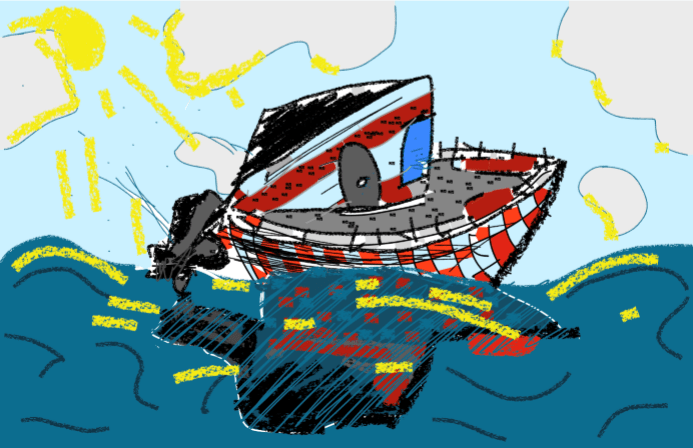
In Croatia we took sailing lessons and learned a lot about sailing boats. I was inspired and wanted to draw a picture of a boat. So here is my drawing of a boat, its called “the little sailor”. The reason I named it that is because if I had a boat, that’s what I would name it. This drawing was made on a app on a computer. That’s why it might look cartoon like.
 Worldschooling