When I first heard of it, I thought Ngorongoro was some little crater with a few animals. Oh but I was sooo wrong. But what I never expected, was a 102 square mile wildlife crater with a mega selection of animals!
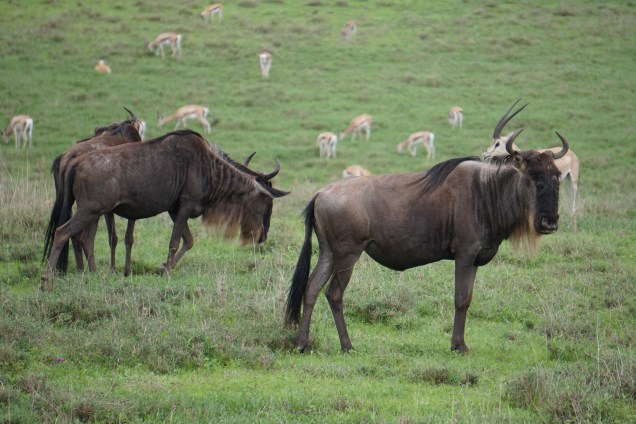
Ngorongoro. Why would something have a name like that? The Masai people of Africa gave the name to this crater. Ngorongoro is named after the cowbell sound ngoro ngoro. But why? Whenever a group of cows was going out to graze, the Masai would tie a cowbell to the lead cow. That way, the village could always hear where the cows were. And since that cowbell was so important to them, they named the area after the sound, Ngorongoro.
But how big is the crater? It is around 10 to 12 miles of length and measures at about 102 square miles area. So now that we have covered that, let’s get deep down to the center of this story…
A crater is usually a piece of land that caved mostly due to volcanic activity. When the ground explodes with magma, the ground will shatter, caving the area into the earth. When rubble clears away, all that is left is a large hole in the ground. That hole in the earth is called a crater. And that is the story of the Ngorongoro. Two and a half million years ago, a huge volcano lay at the place of the Ngorongoro. Some now think that it rose at a similar height of Mount Kilimanjaro, one of the highest peaks on the face of the globe. I think it maybe would make sense for it to be that big, because just looking at the Ngorongoro crater made my ears pop from massiveness. But now the Ngorongoro mountain is no more, because at that time it was very, very active. Two and a half million years ago the massive Ngorongoro peak exploded in ash and lava, not only creating a home for thousands of animals and plants, but also- millions of years later- expanding tourism to a new level of safari.
The first European who visited this area was an Austrian explorer named Oscar Baumann. Oscar, born in 1864, attended natural history classes at the University of Vienna. He visited the Ngorongoro in the year 1892. Many people tried to destroy and take over this natural habitat. This includes two German brothers, Adolph and Friedrich, who farmed in the crater until the outbreak of WWI in 1914. The two brothers killed many buffalos to keep them from eating the grass and crops of the Ngorongoro. During these years proceeding WWI, the Ngorongoro crater was in grave danger. Once the two German brothers left the Ngorongoro, many other people began realizing how much of a perfect habitat the Ngorongoro was, and came mostly to poach animals and to farm on the Ngorongoro land. Eventually the government got involved. So much was happening in the area, that they could not help but check up to if this was okay. So in 1921, the first preservation act was put into use. But the problem was, that hunting was still allowed in the crater. So they passed another ordinance in 1928 to prohibit poaching in the area.
In 1948, people started thinking about a new way to have this crater in the world. 1951, was the year in which the famous Ngorongoro became a very important and protected, national park of Tanzania. Nobody knew that later in its lifetime, the Ngorongoro crater would become a world heritage site, known all around the world.
Life is not always happy in a natural habitat. I know I already told you about the two German brothers killing buffalo in the Ngorongoro crater, but let’s get more animal-wise. Imagine I am a happy Impala, eating nice grass on a good day. I never knew that there was a lion creeping up behind me, and then it lunges up and I get killed. Yep, that’s life! One of the most important things on a wild animal’s mind, is survival. You have to eat, and not get killed. Or you have to kill the other animals, and not get killed by them. There are over 20,000 creatures, both carnivorous and herbivore, who have to think about this every day. Yes, that many.
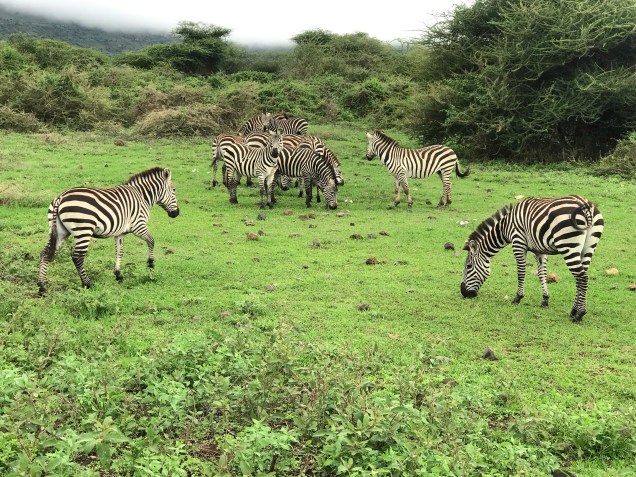
There are so many animals in the Ngorongoro crater. There are around 20 to 26 black rhinos, Among 7,000 wildebeests, 4,000 zebras, 3,000 elands, 3,000 gazelles. Did you know that the Ngorongoro crater has the densest known population of lions? In 2016, there were 70-75 lions.
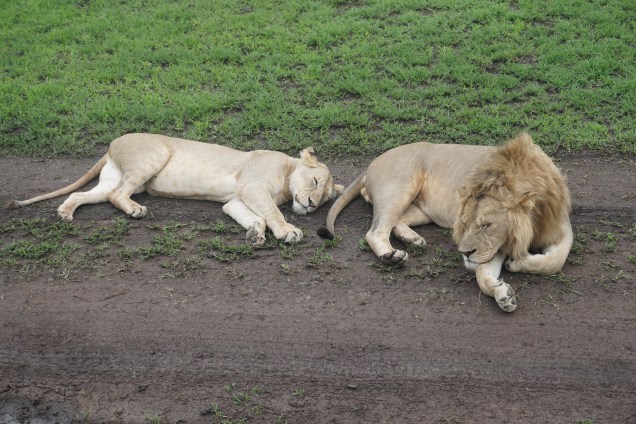
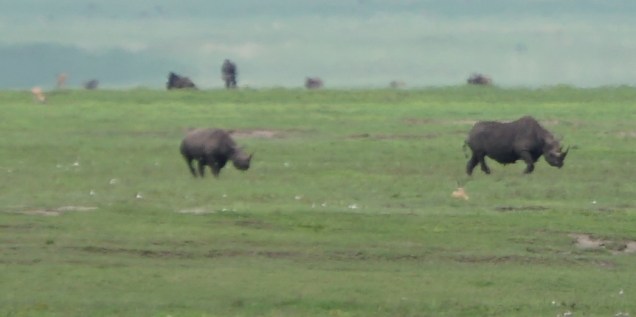
At the end of our safari in the Ngorongoro, we had seen no black rhinos. Apparently there were and still are some in the crater. But as we started to drive out of the area, our driver guide Anin suddenly stopped the truck. “Black rhinos!” he shouted. Even when he pointed to the right of the vehicle, I did not see anything. Finally, I saw two blurred shapes moving from very far away. When I put my eyes to a pair of binoculars, I saw the shape of two rhinoceros walking slowly in our direction. One was large, and one was a lot smaller. It turned out that the two black rhinos, were a mother and a baby. I did not know then, but seeing black rhinos was slightly rare in the Ngorongoro since there are only around 20 left in it. In fact there are only 5,500 black rhinoceros in the whole world! I know that might not sound like a lot, but think of it this way. There are 7 billion humans in the world. But there are only 5,500 black rhinos on the globe. Now you should realize how they are critically endangered. There was a program in 2019 to save black rhinos from extinction by moving some out of South Africa and into Tanzania. In September 2019, nine black rhinoceroses where successfully relocated to Tanzania.
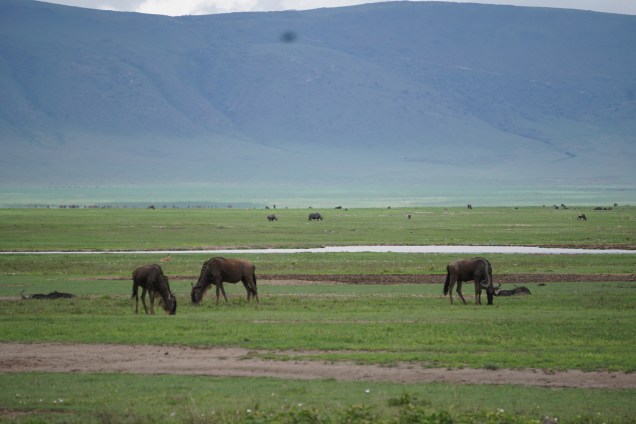
With all that said, I still wonder to this day how Anin our safari guide spotted those black rhinos in the first place, without binoculars, when they could have been miles away.
A pack of lionesses speed fiercely toward a brown dot in the distance. As they gain speed, a crowd of vultures eye them from the tree tops. The lionesses are on their own, with no males to help catch dinner. But that’s just normal for the lionesses, because the males just lounge around and eat, but only help in the hunting if their extra force is needed to bring something heavy down. And that is why the female lions often live for many years longer than males aging up to 19 years. Males barely live to 12. The lionesses get exercise, but the males not as much. Once this pack of female lions finally bring down their prey, it comes into view. A full grown buffalo. The hyaenas smell this from up to 4,300 yards away. The jackals will smell this soon too. Vultures and condors circle the kill in the sky. But everyone waits until the lions are gone. If a scavenger tried to challenge a lion for food, they would not survive it. The lionesses make a loud sound to alert the males of a kill. And finally, once all the lions have no more appetite, the fun begins. Hyaenas stride up to the kill, surveying the amount of meat left for them. The lions have eaten most of the animal, but there is plenty for the other animals to feast on. But not everyone eats at once. All the scavenger animals take turns eating their share, the most powerful of the animals eating first. While the hyaenas eat their share, Jackals take their stance. They are among the second of the scavengers. Finally, the birds get to eat. There’s rarely any meat left for them, so it is usually the bones which these scavengers feast on. When a bone is too large for the vulture to swallow, that is no problem. The bird can just fly up high and drop the bone to the ground so it lands on a sharp rock. So when the vulture swoops back down, it will find its bone split into pieces, ready to be eaten.
Seeing a scavenge is a very rare thing to see in the wild, but it is truly possible. In the wild, seeing a lion outrun another animal and bring it down, is rare, but truly possible. In fact, anything is possible in the crater, of the Ngorongoro.
 Worldschooling
All of those safari pictures of the animals -Shown In the blog post -were taken by us in the Ngorongoro crater.
LikeLike
Wow- all very exciting! Thanks for posting! What do you think, would you rather be a male lion, lounging around taking it easy? or a female lion, working hard, hard, but living longer? Uncle Keith
LikeLike
Well, to directly answer your question, maybe I would be a female, getting more exercise than being a male. The male lions do hunt sometimes, but rarely.
Personally, I would just be an elephant who is part of a large group. The reason for that is first of all, elephants tend to live longer (aging to something around 60 to 70 years). Second, 1 elephant is stronger than one lion. Sure if a pack of lions surrounded an elephant they could take it down. But with a whole group of elephants, the lions would not stand much of a chance.
What about you guys? Male lion, or female lion? Or, what animal would YOU prefer?
LikeLike
We so enjoyed reading your article, Jack, and learning about the formation of Ngorongoro crater and the variety of animal life there. Your pictures are wonderful and you are so fortunate to have seen those black rhinos. It’s interesting that when a lioness takes down a buffalo, the feeding chain extends to other animals in the area. Thanks for sharing this adventure.
Love,
Grandma and Grandpa
LikeLike