Have you ever wondered where camels originated? Or why they have humps? Get ready to learn a lot reading this upcoming blog post because it’s packed with information about camels (specifically those that live in the Sahara desert) that you probably never knew!
WHERE CAMELS ORIGINALLY CAME FROM
You may think that camels came from hot desert climates in Africa, but judging from fossils found on Ellesmere Island in northern Canada, this is false. “Camels actually originated in North America some 45 million years ago”-Jennie Cohen. The fossils found, turned out to be the bones of an arctic camel! Cool right? Before this, I never would have thought camels came from COLD climates all the way in North America. More recently, (according to Jennie Cohen, around 3 to 5 million years ago) camels started migrating south and were introduced to Africa during the trading period. (More on that later!) Its almost unbelievable to think that they came from such cold harsh weather to a hot and parched desert climate. Some camels even moved to South America, eventually evolving into animals such as the llama and alpaca. However, just like other early species, camels living in North America were not so lucky. They ended up dying off and becoming extinct during the ice age.
THE TYPE OF CAMELS THAT LIVE IN THE SAHARA DESERT
In modern times, there are three types of camels. Dromedary camels, Bactrian camels, and wild Bactrian camels. The difference between the species is that Dromedary camels have one hump and Bactrian camels have two. There are around 14 million camels in the world, and Dromedaries are the most common, taking up 94 percent of the worlds camel population (Wikipedia). So which type of camel lives in the Sahara desert? You guessed it. Dromedary camels!
CAMEL FEATURES
The word camel is “Jamal” in Arabic, and means beauty. In fact, the reason camels live so well in the desert is because of how their bodies are built.
Camel heads are small but they have big eyes capable of seeing a long distance in front of them as well as in many directions. Their eyes are very well protected from the sand and sun with their two sets of eyelashes and the help of big bushy eyebrows for extra protection. Camels also have a special eyelid that works like windshield wipers; whenever sand gets in the way of vision, their eyelids move to the side, brushing the sand out of their eyes. During a sand storm camels really have no problem because in addition to having all those extra layers of protection on their eyes, to prevent getting sand in their nose, they can just close their nostrils any time they wish! Deep in the desert, not only do camels have to cope with sandstorms, but when in need of food or water, their lips are very thick, making it possible to eat prickly desert plants (that’s also how they get water) without hurting themselves.
A camel’s facial features are very important parts of their body, but what about how their able to walk on desert dunes without sinking into the sand? Well, camels feet are very big, and the skin on the bottom of their feet is very tough, enabled to walking on hot sand without burning themselves and avoiding the possibility of cutting themselves on sharp rocks. And when traveling long distances through the desert, the padding on a camels feet is a big help to its legs so that it can move steadily.
Another feature on its body that helps a camel adapt to the desert climate, is its fur. The coat of hair covering a camel protects it from the heat of the sun during the day, and keeps the camel warm during the cold of night, because the temperature can drop drastically.
So now you can see why a camel’s features play such a crucial role in how they cope with living in their dusty desert habitat.
WHY CAMELS HAVE HUMPS
A big camel feature that we probably all think of, is the hump of a camel. Some people think that a camel’s hump is filled with water, but that is actually false. A camel’s hump is actually filled with fat which is how they can last so long without water or food. Whenever they need energy, they just take what’s in their emergency store and their hump shrinks down until they’ve consumed more food. Baby camels are born without a hump and don’t gain one until they’ve eaten something solid. This is probably partly how camels gained humps in the first place, but during the arctic times, their humps also gave them extra layers of warmth in the cold weather.
“Camels can go without water for about 5 days in extreme heat or several months in cooler weather,”- desertcampmorocco.com. But if this is true and we know that camel humps DO NOT contain any water, then where does all the water get stored? Well It turns out that camels store water in their blood cells that expand as they drink! And after not drinking for days, camels can take in a very large quantity of water in a short period of time. According to livescience.com, camels can drink 30 gallons of water in just 13 minutes.
A CAMEL’S DIET
Usually camels are not alone in the wild and they have people who care for them. Camels are fed foods such as wheat, grass, grains, and oats (Wikipedia). But when traveling long distances across the Sahara, they have to eat desert plants. Its a good thing camels are Herbivores because, mostly, the only thing to eat out in the plain, barren desert are plants. We already know that camels have thick lips meant for protecting themselves when eating prickly shrubs, so the types of plants they consume in the desert are mainly dried leaves and thorn covered shrubs and bushes.
HOW CAMELS WERE USED DURING THE TRADING PERIOD IN AFRICA
If you’re studying camels, I would say one of the most important things to learn is how camels were used for the trading industry in Africa and how dependable they were. Trade in Africa would have been very difficult without the help of camels. They were such a big part of trading and they are still used today for this same purpose: crossing the desert.
The trade industry in Africa started in the 15th century. Goods were traded with Europe, parts of Asia, and India during this time. Trading posts were stationed in all the major cities in North and West Africa. According to ducksters.com, the main trading locations in West Africa were: Timbuktu, Gao, Agadez, Sijilmasas, and Djenne, and the main trading posts in North Africa were: Marrakech, Tunis, and Cairo.
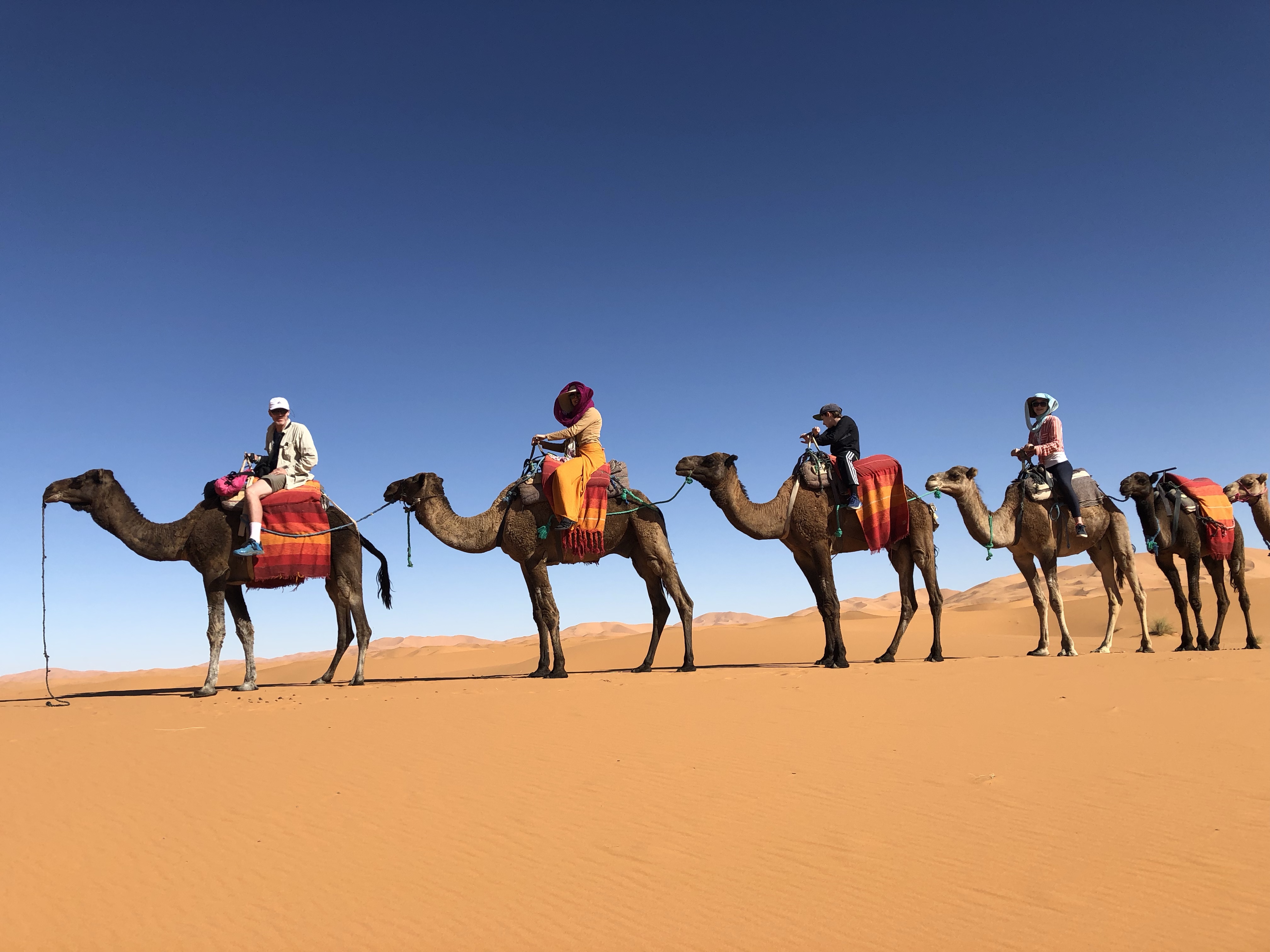
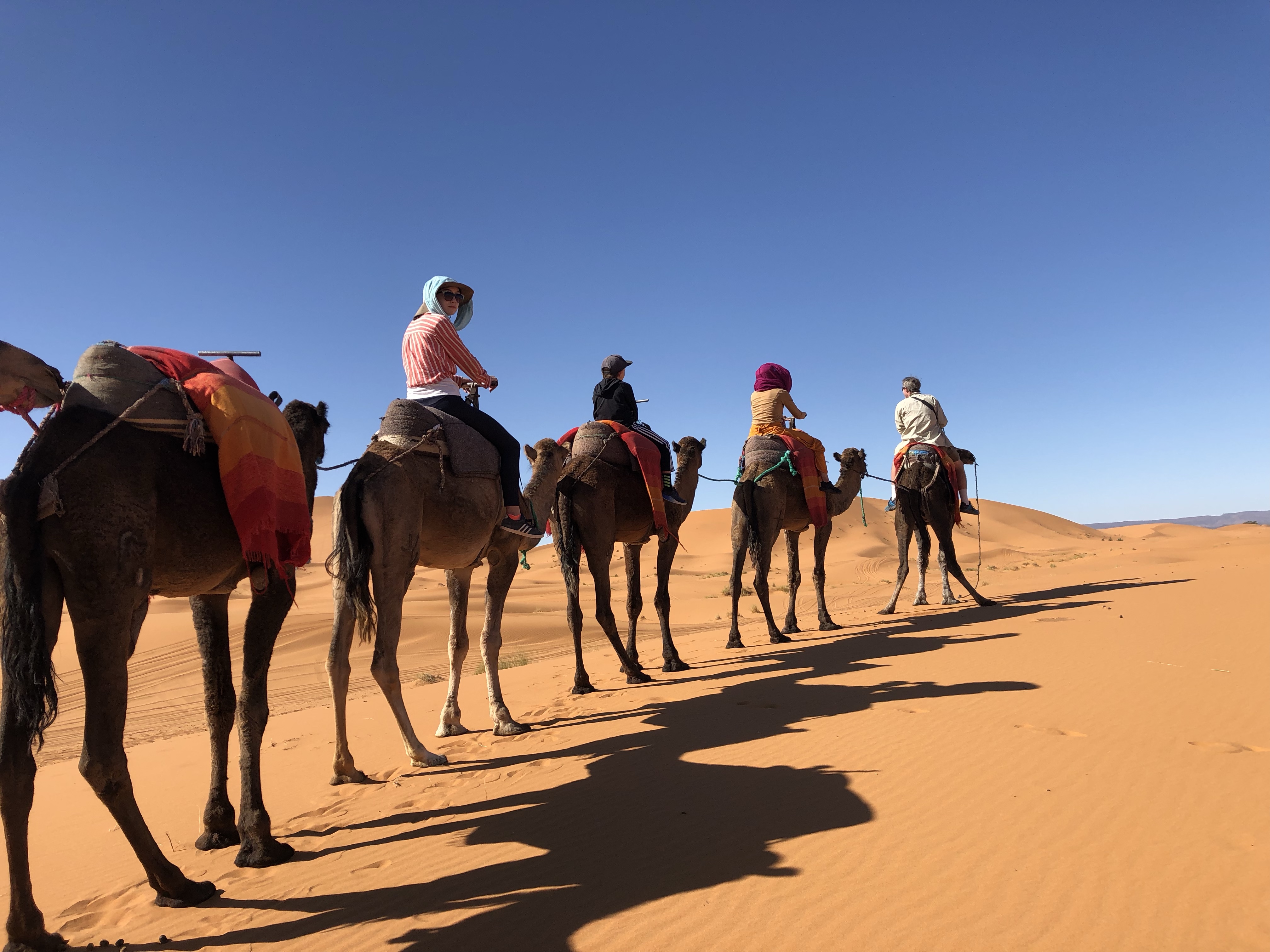
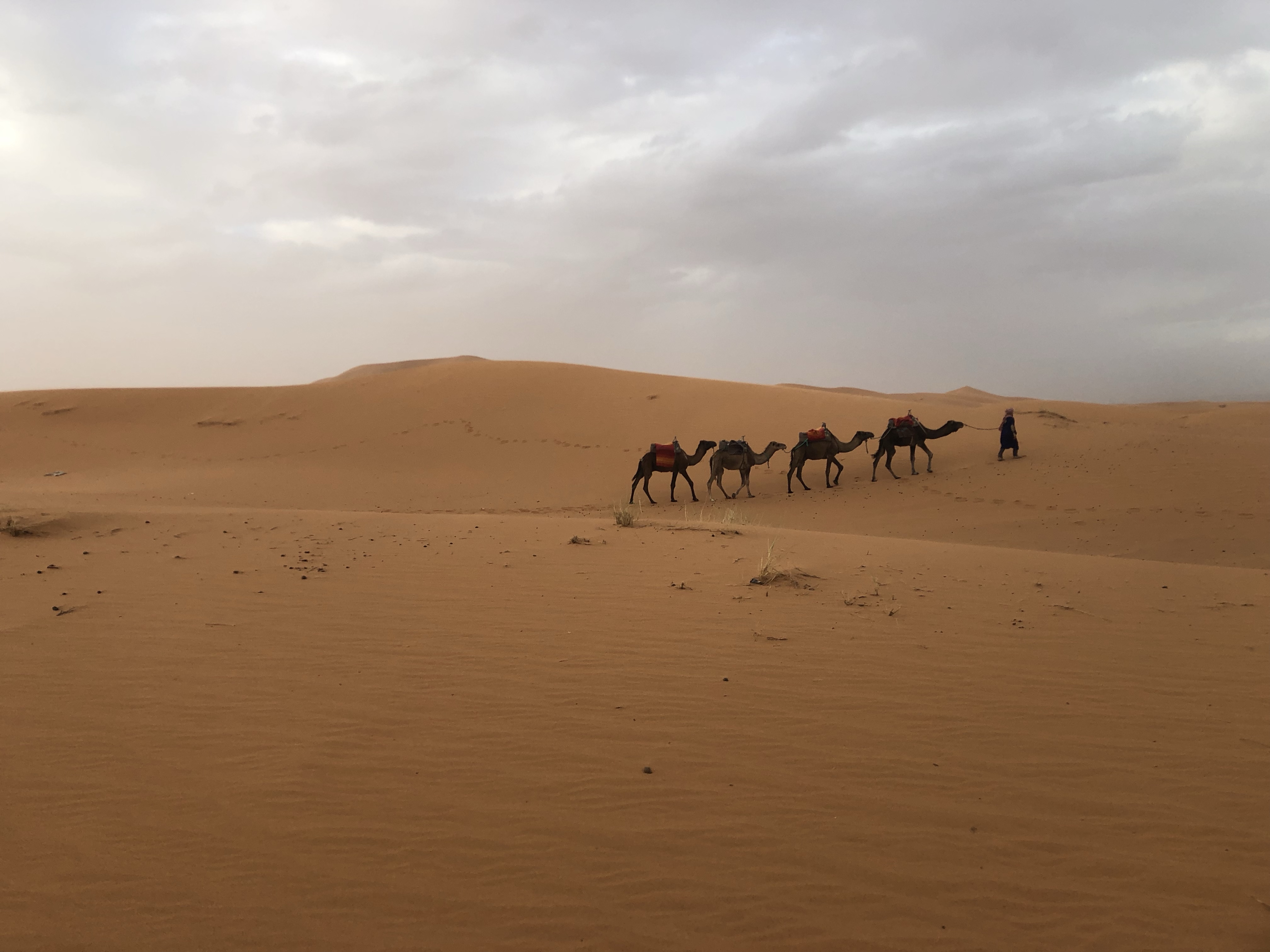
To get to these trading posts, traders would be carried by camel across the desert in large groups called caravans. And when I say large, I mean caravans of 1000 to 10,000 camels and their riders, according to ducksters.com. What does a caravan of camels look like? Well, its basically just a number of camels tied up so that their lined up in a straight line, one camel after another. When I went on a camel ride in Morocco, in the Sahara desert, we traveled in a caravan of about six camels. (See photos down below!) This way of transportation is a very good idea, because it keeps the pack of camels together without the chance of leaving one behind. In fact, elephants travel a similar way, except to keep the whole group together, they grab onto each other’s tails instead. Have you ever seen a picture of a baby elephant trying to keep up with the rest of its stampede? If not, I dare you look it up. It’s adorable!
Traveling in large caravans provided protection against burglary, and, I assume, got large amounts of traders to their destination in a fast period of time. The typical amount of time it took to get a caravan to get to its destination was about 40 days because the camels only moved at a speed of 3 miles an hour (ducksters.com). By traveling on camels, traders could use them to carry their goods. So what goods did they carry/trade? The main things carried/ traded were salt and gold from the mines in West Africa. Beads, Ivory, nuts, cloth, and metal materials were also traded (ducksters.com). Slaves were also brought and traded as well.
BIBLIOGRAPHY
(You should check out these links!)
https://www.ducksters.com/history/africa/trade_routes_of_ancient_africa.php
https://www.desertcampmorocco.com/blog/post.php?s=2017-04-01-desert-camels-one- hump-or-two
https://www.history.com/news/giant-ancient-camel-roamed-the-arctic https://www.livescience.com/27503-camels.html https://en.m.wikipedia.org/wiki/Camel
AUTHOR OVERVIEW
Thanks for reading this blog post! I worked really hard on it because, you know, its always hard to find the right facts and if their true or not. I tried to include some background history and information about where camels came from and what they were used for originally in this post, and a lot of sources and references.
I definitely learned a lot about camels while writing this. For example, I never knew camels originated in North America! I guess I always thought that they came from Africa, but in reality, I don’t think I’ve ever thought about it. I also didn’t know that Bactrian camels live in Asia, and that Australia is also home to camels too! Although I didn’t include any of this in the post because I was focusing on camels living in the Sahara.
Anyways, make sure to stayed tuned with our YouTube channel, we’ll be posting a new video ASAP. And make sure to subscribe to our blog AND our YouTube channel as always. Also, make sure to turn your notifications on so that you get notified every time we upload a new blog post or video!
Until next post! -🍦
 Worldschooling
Thank you for the background of the dromedary camel in the Sahara that you wrote about. It’s quite amazing that camels still provide the transportation through the desert as they have throughout the centuries. Trade over long distances, is of course transported by modern vehicles, but camels still have their place in that society and are enjoyed by tourists such as you.
Keep on exploring, researching, and writing about all the things you are experiencing. I am learning so much!
Love, Grandma
LikeLike
I’m glad you learned so much about camels! Like I said in my post, I also learned a lot too and had a lot of fun writing it. My next blog post will probably be about what we did in Zanzibar or maybe about the fruit that grows there.
>
LikeLike
Lily, why has Zanzibar been part of Tanzania sometimes, and an independent country sometimes? Do you know? Can you tell me? Love, Grandpa.
LikeLike
Hi Grandpere,
Finally starting to answer your question! Tanzania became an independent country in 1964 when Tanganyika and Zanzibar joined together and became ”Tanzania.” Zanzibar was ruled by Portugal in 1503, then Oman in 1698, then Britain in 1890. Looking forward to talking more when I see you soon!!
Love, Lily
LikeLike
I’m enjoying your research! Keep it up!
LikeLike
Hey lily and Jack:) I just caught up on some of your blog posts and videos and I just love them. You two are really learning so much and I’m sure this experience will provide you with life long memories! We are heading to London to see Luke for Thanksgiving and will be visiting the Tower of London. I loved seeing the prisoners names inscribed on the walls the last time I was there. It was just so creepy! Anyway, Shane was only 5 then, so we will go back because he doesn’t really remember. I also love the royal jewels!! Keep up the good work with all of your posts and be safe on your journey…and remember America on Thanksgiving. The world abroad is big and amazing, but home sweet home is super special 🦃🇺🇸! Hugs, Melissa
LikeLike
Lily, I thought that I was reading the Encyclopedia Americana article regarding camels in Africa, but it was your article. Wonderful! I have ridden bactrians in India, but never in Africa. Love, Grandpa.
LikeLike
That’s so cool that you rode Bactrian camels in India especially since their a lot more rare than dromedary ones. I thought it was really fun writing that article, and glad you liked it!
>
LikeLike